Skip to content

Understand health coverage

As your child becomes an adult, their health coverage and benefits may change. You can help them navigate this transition effectively.

Health coverage concepts and options

If health coverage is a new topic for your child, describe how it helps to pay for doctor visits so a person don't have to pay for everything themselves. You can introduce coverage topics like premiums, deductibles, co-pays, co-insurance and in- and out-of-network providers. If your child will be transitioning to a new health plan, encourage questions and find answers together to build confidence and understanding.

The best type of health coverage for your child depends on their circumstances. Health coverage options include:

  • Parent plans: Check to see if your child has continue eligibility for coverage through your health plan. In Minnesota, parent employer health plans can typically extend coverage to an adult child up to age 26, even if the child is no longer a student or living at home. Children can also be covered by a parent's marketplace plan up to age 26 as well. Learn more about how to get or keep a child on a parent's plan until age 26.

  • Employer health plans: If your child is working, explore if there are employer-based health coverage options available.

  • College student health plans: Many colleges offer student health insurance plans that provide access to campus health services and help cover medical care while your child is enrolled in school.

  • Public coverage: Depending on their circumstances, your child may qualify for federal- or state-supported health coverage, like Medical Assistance (MA), MinnesotaCare or other programs. Learn more about public coverage options in the section below and about MA rules that change at age 18 and 21.

  • Individual coverage: Individual marketplace plans are also an option, and your child may qualify for subsidies through their state's marketplace, like MNSure. Plans can also be purchased directly from insurance companies. Learn more about other options like individual coverage. 

After identifying the health coverage options that would work best, review the process and timelines for applying for coverage.

Ways to support your child in getting health coverage

From Medical Assistance to employer-sponsored coverage, your child and you can find an option that works best for them.

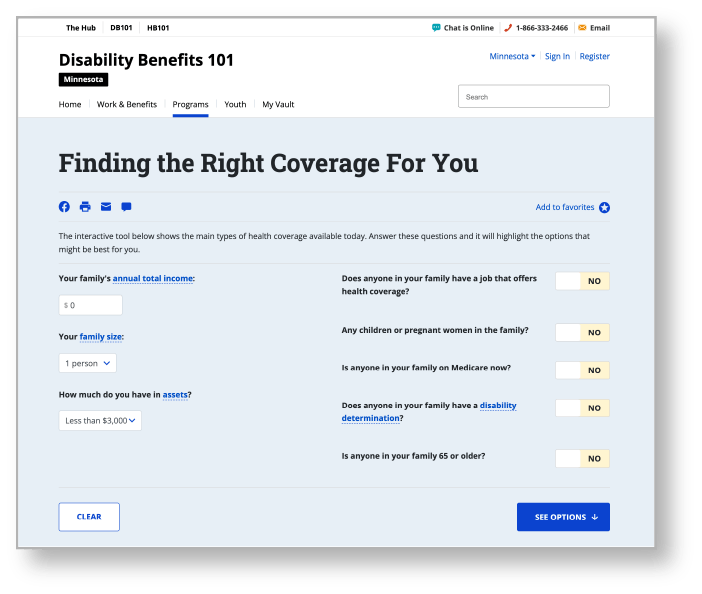
Together with your child, use DB101's interactive "Finding the right coverage for you" tool to explore which health care options might be best based on their circumstances and income.

[LN questions: Any instructions / reminders to go with this tool? For example, is the following correct?

If your child currently has Medical Assistance (MA), or to see if they might be eligible, select a family size of 1 and only include your child's income if any (do not include parents' income). [Otherwise it seems like Disability-based MA won't show as an option in the tool for a child in a family with high income...]

For options other than MA:

  • If you are looking for coverage for a child who is your dependent, fill out the tool based on your family (the people in your family who are living together and listed on the same tax return).

  • For a child who is no longer a dependent, fill out the tool based on the child's individual information.

If you think your child may be eligible, learn more about public coverage options on the Disability Hub and Disability Benefits 101 (DB101) websites:

Disability Hub MN

DB101

[LN question: Health coverage options can be complex and seem overwhelming, perhaps this would be a good place to promote talking with a Hub expert for more help understanding and navigating these programs and their eligibility and applications? ]

SSI is a cash benefit. Is there another place to promote understanding and applying for benefits in general?

Chat, call or email the Hub.

At the Hub, there’s no such thing as a wrong question. We're here to help. Contact us Monday to Friday, 8:30 am to 5 pm.