Plan for independence

As your child gets older, building confidence in themselves and their skills while still living at home is an important step toward adult life. Understanding their strengths and planning for the support they'll need helps them make important life decisions.

Ways to build life skills and prepare for independence
You can help your child develop everyday skills like managing money, building healthy relationships, and knowing how to get help when needed. These skills work together to help your child become as independent as they want to be.
-
What types of assistive technology (AT) could help your young adult live more independently at home and in the community? AT are tools that support communication, mobility, organization or daily tasks. AT can be simple, like a talking alarm clock, visual schedules or magnifiers, or more complex, such as speech-generating devices, mobility aids, hearing aids, or apps that support organization and memory.
Connect with your child’s support team
If your child has an IEP, discussing and exploring AT for adulthood is an important part of their planning during the year before they graduate from high school.
Try assistive technology devices
Trying something out before buying it is a great way to see what’s available to meet your child's needs. The following programs allow you to try assistive technology before you buy it.
The Minnesota STAR Program provides device loans and has an online AT lending library: Minnesota Assistive Technology for All. STAR can also provide device demonstrations and trainings.
Simon Technology Center at PACER Center has a lending library and provides guided explorations and trainings for AT.
Explore how assistive technology can help at school and work
Minnesota’s Guide to Assistive Technology can help with next steps to finding the right AT for your family.
-
You can help your child learn how to care for their daily needs and home by:
Teaching basic home-care tasks, such as taking out the trash, changing a lightbulb or doing the dishes.
Introducing budgeting for rent and utilities.
Teaching them how to prepare meals and care for clothing. [LND added based on YIT Toolkit for professionals]
Practicing phone etiquette and digital literacy skills. [LND added based on YIT Toolkit for professionals]
Practicing safety routines, like what to do in an emergency—learn more about helping your child stay safe.
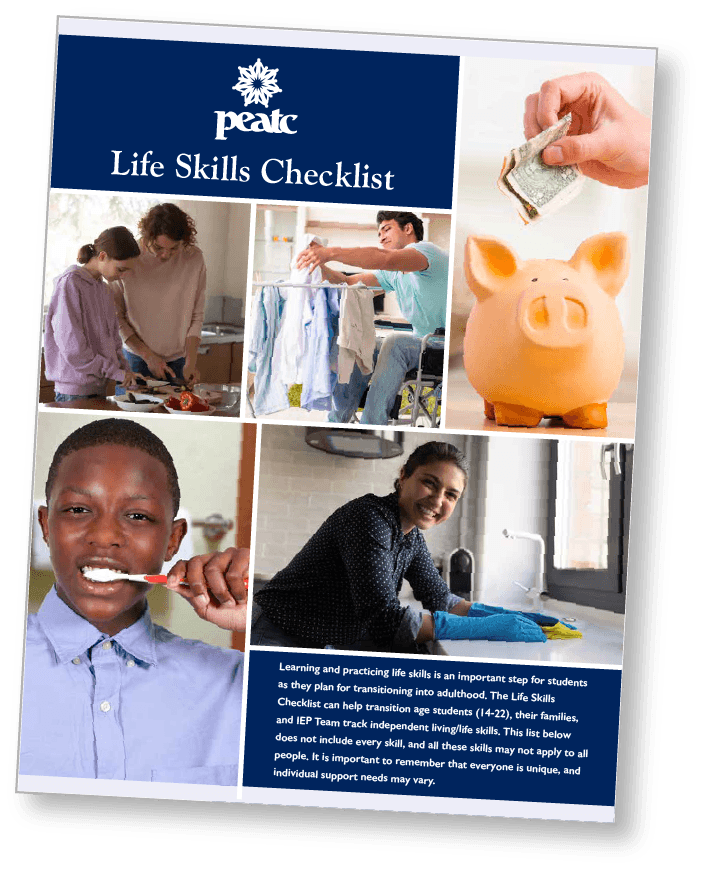
The Parent Educational Advocacy Training Center (PEATC) offers a life skills checklist (PDF) for parents, youth and their IEP teams to track household skills like these and more. [This is on the "Help your child stay safe" page as well. LND added here since it has lots of daily living skills too.]
-
Where will your child live after high school? Living independently can take place in a variety of settings, whether a person owns or rents their own house or apartment, lives with others (with or without supports), or remains in the family home.
Start conversations with your youth about where they want to live after school
Use the Housing Guide for Young People from HB101 to get started.
Build a plan for housing
Disability Hub MN's online My Vault tool can help youth explore and set goals for their life in the community. My Vault’s housing paths and activities can help youth create a housing budget and build a housing plan. After an activity, discuss how you and your child can use the results to build a plan to reach their goals and advocate for what they want. Learn more about My Vault.
-
Helping your young adult manage money is an important step toward independence. This can include teaching budgeting, using a bank account or debit card, setting up automatic bill payments, or using apps to track spending. Practicing these skills with your child now to build confidence for managing finances after high school.
Start money conversations now
Earning money and learning how to manage it are important parts of being independent.
Open a bank account. Help your child get a checking or savings account and learn how to use it.
Practice budgeting. Review income, expenses, and create a savings goal together.
Teach bill payment. Show how to pay bills online, by app or by mail.
Introduce credit basics. Discuss responsible use of credit cards and loans, and the importance of managing or avoiding debt.
-
For many people with disabilities, finding transportation options can be hard. Limited options can impact their ability to explore the community, interact with friends and family, and engage in hobbies. Supporting your young adult in finding transportation is about understanding the available options - such as getting a driver's license, practicing public transportation, using community resources, reaching out to friends or family for help, or exploring app-based options such as Lyft or Uber - and encouraging the use of these options as independently as possible.
Complete a driving assessment
If driving is a goal, a driving assessment and training may help your child stay independent on the road. Allina Health offers a two-part comprehensive driving assessment.
Review driver's license requirements
The Minnesota Department of Public Safety offers instructions for getting a driver's permit and license.
Explore local transportation options
Use Minnesota transit links from the American Public Transportation Association to help youth identify public transportation options available in their community.
Look into specialized transportation services
Options include Transit Link, Metro Mobility and Nonemergency Medical Transportation (NEMT).
-
Being independent includes learning to take care of health needs and navigating health care into adulthood. See our Transtion to Adulthood > Health section for practical steps to help your young adult learn to manage their health and health care. [LND added this accordion based on the YIT toolkit for professionals and it creates a nice crosslink with other content.)
Hear what young adults have to say about independent living
Watch this 5-minute video to hear what young adults say about independent living and how they prepared for it.
 Chat
Chat 1-866-333-2466
 Email
Email